Showing posts with label Selecting Final Ideas. Show all posts

Tuesday, 20 February 2007


Prototyping Design

The group met today to finalize the prototype for our teaching assistant. From analyzing our persona's and scenarios, we formulated our design for the Teaching Assistant: -


Please click on the image for a full sized screenshot


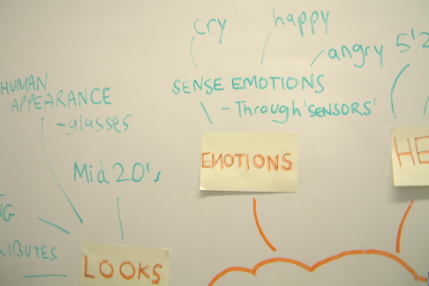
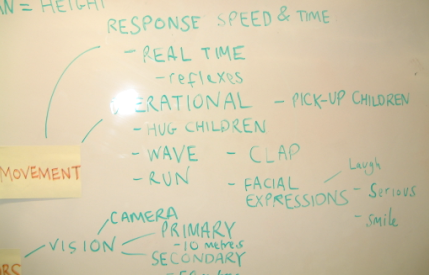
We primarily focused our efforts on 7 key areas, such as Emotions, Height, Movement, Sensors, Speed, Looks/Appearance and Network: -


In terms of Sensors, we analyzed different areas such as vision, touch and hearing. : -


Emotions: -


Movement: -


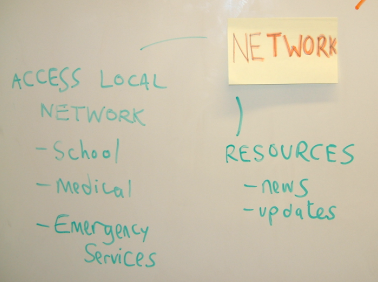
Network, the Teaching Assistant will have an in-built wireless fidelity card which allows the robot to access local educational network and emergency services: -

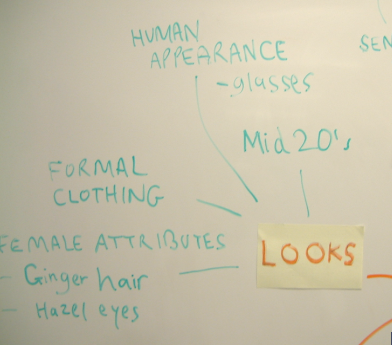
As already been stated the teaching assistant will adopt a female look.


Speed - It was important to consider the relative speed the robot will have compared to children. It should be possible that the Robot matches the same motorized speed as that of the walking speed of a child.: -


Other - In this section we detailed any extra functionality of the Teaching Assistant: -
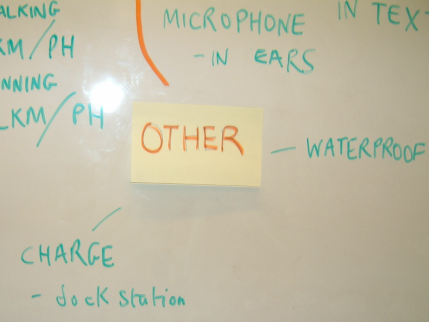

In terms of the Teaching Assistant being waterproof, the robot will have a waterproof fabric laminated onto its 'skin', thereby reducing the risk water may have on the robot.

Furthermore, from this prototyping session, we will be able to draw conceptual designs of the robot.


Monday, 5 February 2007

The Second Stage

The ideas that I put forward are Software System for Children and Virtual Blackboard.


  • Software System can be implemented currently. The existing software systems for children, although have interesting graphics but, they are still complex for children to use.

  • Virtual Blackboard is more futuristic but if it is implemented it would help children to learn better at school.


I have decided against voice to melody recognition because:
  • A real instrument can attract children more into learning music than simulated software.

  • Alternative software such as FlexiMusic Kids Composer which allows kids to compose and record music already exists.

The Second Stage


    The two ideas I have decided to put forward are the speech recognition software and the computer watch scheduler. I have therefore decided against the mind interpreter, for the following reasons:


  • The idea is too futuristic, which means that many assumptions would have to be made about the technology.

  • There is an ethical issue regarding the whole concept. Is it fair to read someone's thoughts?

  • It would be difficult to prove that the interpreter is correct.

  • There are similar products on the market already like baby monitors.


    The speech recognition software has the potential of being a useful teaching tool. This idea would have to assume that a child's speech could be interpreted effectively.

    The computer watch scheduler does not have any prerequisites.


The Second Stage

The two designs that Taiyyib chose to make were the inflatable vest
and the tracking device. Taiyyib had done an analysis of
why he had chosen these and why the others were inappropriate.


Inflatable vest

We found
that such a technology would in fact create more problems in the long run. If we
did chose this idea, there would be a lot of complaints if such a vest did not
deliver the goods, therefore the reason being of that it would not dominate the
market


  • Inaccurate judgement

  • Refuse to wear the vest due to it being irritable

  • Amount of pressure to exert on the child

  • Height and weight would need to be considered, so in fact would need to be
    custom made

  • Unrealistic

  • Can be done now with use of different technologies

  • Complaints maybe suing the makersExperiencing
    violence
Tracking device
This is a much heated
debate in today’s society, although it may in fact help, it is prone to
disasters. Issues arising include


  • Privacy invaded
  • How would the device be implanted in the child
  • Long term dangers occurring in the body
  • Hackers could track the child and stalk them which will increase crime
  • Allows would be hackers to learn a routine
  • Computer glitches, failure rate is said to hover around 10-15% [Spooner]
  • Strict guidelines would need to be imposed (e.g. how it should be used?
    Etc)
Speech recognition for disabled childrenThis
technology may not be correct 100% of the time, since research is still going
into it and it still will not allow for 100% speech recognition but it is fast
evolving.

Remote control spy bug
This technology is
already on the market and could potentially create risks, I have listed a few
drawbacks to say why we did not chose this approach


  • Spy on important conversations
  • Conversations can be disturbing
  • Easy breakable
  • A lot of technical issues may arise
  • Experiencing violence

Sunday, 4 February 2007


The Second Stage

The two ideas that I have put forward is the Interactive GUI Monitor and the Robot Teaching Assistant. The ideas can be seen as educational tools which can motivate children and make the experience enjoyable. Although these two ideas can be perceived as futuristic, the technologies used to design such systems are available in today’s world.

The Children Anti-Gravity Chamber was not put forward to the second stage of the evaluation due to these reasons: -

  • What if several children injure themselves within the chamber? What health & safety measures can prevent the likelihood of injury?
  • Is this really necessary for a child’s development?
  • There are safer alternatives for physical exercise for children.


    The Baby Monitor For Children In Cars was also not put forward due to these reasons: -

  • Could pose a distraction to the driver/parent when driving within a vehicle.
  • May not necessarily solve the problem of comforting one’s child.
  • Would this be more of a tool for parents as opposed to the child?


    In analyzing the two ideas that I have put forward for stage two, it must be stated that the technologies for both systems are available in today’s world. This can be an important aspect in bringing the technology to life during the prototyping stage when we will be asked to produce a mock-up of the system, as we will be able to backup technological claims by referencing the technologies used today. There is, however, an assumption which I do make: -


  • The Robot Teaching Assistant will be able to interact within groups (i.e. a classroom) and individually.


  • Saturday, 3 February 2007


    The Second Stage

    I have decided to put forward the Virtual Classroom and 3D Educational Environment ideas. Both of these ideas are futuristic and involve making the educational process more interactive and enjoyable.

    The Baby Language Interpretor was not put forward to the second stage due to a number of reasons:
    • How would we know that the system was working? May result in the child getting more distressed if the wrong interpretation is provided by the system

    • Is the child to young for this type of technology?

    • Some argue that letting a child cry is good for them
      link


    The Automatic Tie-Up Shoes idea was not put forward to the second stage due to a number of reasons:
    • Health and Safety issues

      • What if the shoes are too tight?

      • What if the child has difficulty taking the shoes off?


    • The technology does not really make the lives of the children/parents/supervisors easier as the time taken to tie shoe-lasses is negligible


    As a final point, I must stress that I am making significant assumptions about the ideas that I have put forward,

    • Hologram technology would have developed to the extend where the
      children can touch and feel the holograms

    • The holagram can respond

    • The children will understand that the holagram is not "real"